Boston
The Plot Against AmericaBoston becomes a decisive test of whether Walter Winchell can campaign against Lindbergh’s government in public. At Perkins Square, hostility toward Winchell turns into an organized attack; the city’s slow police response contrasts with Governor Leverett Saltonstall’s intervention. Boston then serves as a rare setting where state authorities act to protect the candidate and enforce order as he continues to speak.
Setting and Campaign
Boston was the northern destination of Winchell’s expanding campaign. After spending a day in each of New York City’s other boroughs, he traveled through Connecticut, Rhode Island, and Massachusetts, speaking in industrial towns including Bridgeport, New London, Fall River, Brockton, and Quincy. He arrived in Boston intending to spend three days moving through Dorchester and South Boston toward the North End. The campaign brought his denunciation of the president’s politics into places where he could encounter audiences beyond the protection he had had in New York City.
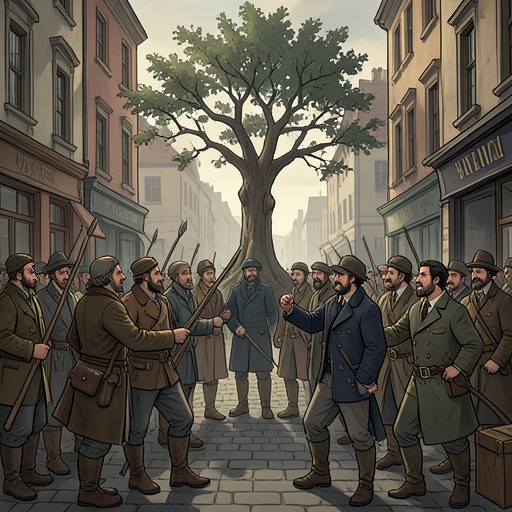
The planned Boston route was cut short on Winchell’s first afternoon in South Boston. At busy Perkins Square, heckling directed at him as a Jew escalated into a mob, with handmade placards recalling those at German-American Bund rallies. The attack unfolded in a neighborhood of shops, streetcars, and houses, near St. Augustine’s Church. In this setting, Winchell’s campaign ceased to be only a series of speeches: the threat against a candidate’s ability to speak became visible in a public square.
The Attack at Perkins Square
As Winchell began to address the crowd, an attacker approached with a burning cross, and two shots were fired into the air. Men in the crowd surged forward, while the Boston police did not arrive promptly; a squad car appeared only about an hour after the shots. The source leaves open whether the gunfire served as a signal to the rioters, a warning to Winchell, or both. What is clear is that the attack was described as premeditated, and that the immediate danger was not contained by local police.
Winchell’s armed professional bodyguards got him away from the crowd and drove him to Carney Hospital on Telegraph Hill, where he was treated for his injuries. The violence did not produce fatalities, but its political consequence was unmistakable. The assault made the campaign he had launched in New York into a confrontation with the hostility his speeches were naming. Boston was where, in the narrator’s account, the public image of Lindbergh’s affable leadership gave way to a more coercive reality.
Saltonstall’s Intervention
Winchell’s first visitor at the hospital was not Boston’s mayor or the local congressman, but Massachusetts Governor Leverett Saltonstall. He left his State House office to express concern, promised an investigation into the attack, and offered protection from state police and, if necessary, the National Guard for as long as Winchell campaigned in Massachusetts. Before leaving, he arranged for two armed troopers to stand outside Winchell’s room.
Winchell welcomed the offer but declined assistance in a statement to reporters at the hospital. He framed the need for armed protection as a warning about the condition of political speech and rejected the idea that religious intolerance had already overcome ordinary respect between Americans of different faiths. Rather than treating the assault as an isolated danger to his own safety, he made it evidence in his argument against the president’s politics. His appearance before the press, still in hospital dressings, brought that argument directly into the national campaign.
Saltonstall’s response also distinguished Boston from many of the other places Winchell visited. He directed state forces to maintain order and, if necessary, use force to take violent agitators into custody. Winchell continued campaigning in Massachusetts, using a cane while his injuries healed. At churches from Gate of Heaven in South Boston to St. Gabriel’s Monastery in Brighton, he drew hostile crowds, but Saltonstall’s orders meant that such gatherings did not unfold with the same impunity described elsewhere.
Political Significance
Boston’s importance lies in the contrast between the delayed arrival of local police and the governor’s decision to act. The city is neither presented as uniformly protective nor as simply indistinguishable from places where authorities tolerated unrest. Instead, its institutions respond unevenly: the attack proceeds in public, but Saltonstall makes the state responsible for protecting Winchell’s continued campaign and restraining violence.
That contrast gives Boston a specific role in the political narrative. Winchell’s tour repeatedly brings him into communities where antisemitic hostility can become a physical threat; the Boston episode shows both the danger of that strategy and its intended exposure of the forces beneath Lindbergh’s public image. The city becomes a measure of what government can do when a candidate’s right to speak is endangered—and of what is at stake when authorities fail to act promptly.